Thursday, June 18, 2009

Four guiding precepts for environmentalists

Dave Foreman's recent "Around the Campfire" post starts a bit melancholy: He laments the passing of several noted environmental activists, including Congressman John Seiberling, deep ecologist Arne Naess, biologists Dave Maehr, river conservationist Pete Lavigne, and others.

Foreman saves his greatest eulogy, though, for Clif Merritt. "Clif is likely not well known to conservationists these days," Foreman says, "but I wouldn’t shy from putting him on the list of the top half-dozen wilderness heroes of the twentieth century."

Merritt, who passed at 89, was director of The Wilderness Society’s western regional office in Denver in the 1960s and through the 1970s, and was a formidable Wilderness advocate.

And Merritt was the one who taught Foreman four rules for environmentalists that Foreman says changed his life and his activism for ever. And stand as excellent guidelines for all of us who care about wildness and wilderness to be reminded of today.

Those four precepts, according to Foreman, are:
First is that the real work of conservation is to shield wild places with clear boundaries, solid rules, and enforcement. In the United States at least, Wilderness Area designation is the best way to do that.

Second is that the heart of conservation is made up of citizen conservationists. Conservation is a family of Nature lovers, not an assortment of institutions. Clif always told us Wilderness Society reps to strengthen independent local and state wilderness groups, to give credit to citizen volunteers and local groups, and to not elbow them out of the way to claim accomplishments for The Wilderness Society or any other big national group. We could lead but were not to hog the limelight.

Third is to ask for and work for what we want, what is needed, what is right, and not to accept what is offered us or what we are told is “reasonable” or “practical.” We are advocates for wild things; we are not politicians juggling interest groups with an eye to the next election. In the 1970s, Clif led against watered-down alternatives to Wilderness Areas such as “backcountry” and a lesser kind of wilderness for Eastern national forests.

Fourth is to have a vision. Since the days when he worked for passage of the Wilderness Act, Clif was carried along by vision. By looking ahead for the big picture, he was ready to head off on new paths that beckoned—for example, he jumped onto the idea of wildlife linkages between Wilderness Areas in 1993, just after The Wildlands Project began to push them. From a practical standpoint, we gain far more when we strive for a vision.
It's pretty easy to see, I think, how these compass bearings guided Foreman in his long career from Earth First!, to the Wildlands Project, and now with the Rewilding Project.

How might they live past Clif Merritt -- and even the Dave Foreman's of the world -- to guide the next guardians of the wild?

"The best way for us to honor this wise, dedicated, and charmingly odd man," concludes Foreman, "is to think about his four lessons, guide our work by them, and insist that conservation groups big and small get back to following them."

And to give those vision life in our own individual actions. And lives.

******

Read about Clif Merritt here.

Visit the Rewilding Project here.

Read and subscribe to Dave Foreman's "Around the Campfire" here.


Monday, June 15, 2009

Hanging with the Wild Hunters

I had the pleasure Friday night to sit around the campfire with some of my heroes: The hunters and fishermen who run the Colorado chapter of Backcountry Hunters and Anglers.

Backcountry Hunters and Anglers is a national organization founded in 2004 that has filled a void and closed a schism in the battle to protect wild country: It finally gives sportsmen and sportswomen a place to unite in the defense of wildness and wilderness, but in the name of hunting and fishing. Prior to this group, so-called "environmentalists" and wilderness defenders were perceived as being in opposition to sportsmen, and vice versa.

Even though hunters and fishermen standing up for wild habitat is a tradition that can be traced back to Teddy Roosevelt and earlier, for generations this natural alliance has been kept severed by the generally ideologically (an also illogically) anti-wilderness stance of traditional "sportsmen" groups. And traditional "environmental" groups maintained a leeriness of hunters and fishermen, largely because of the reactionary pro-motorized and mechanized "sporting" mindset maintained by those industry-backed so-called "sportsmen" groups.

Enter BHA. Here is a group that argues -- eloquently and fervently -- that hunting and fishing need big, healthy, roadless wilderness and wild country. And that it's needed not just for the wildlife that is the object of their woodsmen passions, but also for the health and spirit of those hunters and fishermen themselves.

The group, then, takes some surprising -- and welcome -- stances that stand in stark opposition to the industry-co-opted sportsmen organizations and publications:
  • That hunting and fishing are activities enjoyed by both men and women.
  • That non-motorized, human-powered, low-tech ways of getting around and doing that hunting and fishing is better and healthier for both the land and the people out on it.
  • That these places and traditions need to be preserved not just for today, but for future generations. Toward that end, BHA has a strong componnet of education and family that is meant to reintroduce the values of hunting and fishing to America's youth.
Good people doing good work.

And there was no better place to get to meet and talk with these good people than around a campfire and under the stars of a lovely San Juan Mountain night.

Below is a profile I wrote of the group when it first organized.
Solitude. Tradition. Challenge. Freedom. Health. Family.

Now there’s a list, eh? And how do you come by those good things?

By hunting and fishing in big, wild, open spaces, according to the vision of a new sort of environmental group. Or a new sort of hunting organization. Or a new kind of fishing advocacy club. Or whatever it is, for unlike any other kind of pro-wilderness coalition out there, Backcountry Hunters and Anglers is all those things.

“Backcountry Hunters and Anglers is dedicated to quality and ethical hunting and fishing opportunities in the wildlands of North America, and the aggressive protection of wilderness and other backcountry habitat for fish and wildlife, upon which these great traditions depend,” states the group’s proclamation.

Their statement continues: “We are dedicated hunters and anglers who cherish the peace, solitude and challenge of the backcountry experience. As hunters and anglers, we know that our continued enjoyment of these traditions is dependent upon the protection and enhancement of a healthy environment.”

“At no other time in history have our traditions been threatened like they are today,” the message concludes.

Those “threats” to those traditions and the backcountry they require include the federal government’s recent rescission of protection for the country’s last 58 million acres of roadless land outside of Wilderness Areas. Roadless areas are vital habitat for large animals such as elk and bear, as well as providing essential native trout fisheries. The effects of roads -- even small logging roads and ATVs trails – and the access they cut into backcountry areas include increased human visitation and impacts, stress and altered natural behavior for wildlife, stream sedimentation, engine noise, access for poachers, and the spreading of noxious plants. Roads also disqualify areas from future Wilderness designation.

To counter those threats, BHA aggressively supports roadless area protection and Wilderness Area designation. It also, though, goes beyond these issues to also advocate for the reintroduction of predators such as wolves where viable, off-road vehicle restrictions, and minimizing technology for hunting and fishing -- all stances that stand in direct opposition to the messages conveyed in most modern mainstream hunting and fishing media, where wilderness “locks up” the land, roadless areas prohibit access to backcountry, predators steal “our” game, and ORVs and technology give you the edge up on those wily animals (while providing big advertising dollars in those glossy sportsman magazines).

It’s a radical approach, then, uniting hunters and anglers by promoting the protection of wild country and healthy ecosystems. The key rallying point is a shared valuing of tradition: renouncing motors and gadgets in favor of muscle and mind in pursuit of game. But it’s not a new philosophy, argues BCA co-founder and chairman Mike Beagle.

“It’s the freedom to hunt and fish in solitude, without urban excesses, and with challenge,” he explains. “It’s an old-fashioned way of doing things, that says it’s demeaning to wildlife to use technology to show our mastery over wildlife.”

Beagle, a former army officer, high school teacher, and football coach living in Oregon, refers back to Teddy Roosevelt when he talks about “the doctrine of the strenuous life”-- getting yourself in and out of the backcountry by your own power, and meeting your prey on their turf and level. All it requires is leaving the land alone, and leaving the toys at home. Which, of course, would also keep many of the motor-and-technology-dependent so-called hunters and fishermen at home, too. Like it used to be.

So that’s the solitude, tradition, challenge, and freedom parts. From that, the health and family benefits of low-tech adventuring in motor-free backcountry are gravy, says Beagle. “There’s also the added value of it being great for families. Real ‘family values.’ And it doesn’t cost like a theme park. All we have to do to get into it is sweat. We have to earn it. And even at a young age, kids understand the idea of earning it.”

“We just have to protect the solitude and challenging environments, by educating hunters and anglers about wild habitat,” he says, summarizing BHA’s approach. “We’re not against anything – we’re for things.”

Holly Endersby agrees.

“I joined because there wasn’t another organization out there that shared my values,” says Endersby, an Idaho-based outdoors writer, horsewoman, hunter, and angler. “All the rest were us-against-them groups.”

BHA, she says, appealed to her because of “their unique stress on protecting wild public country” and “a value that has lost its hold in the last few years – that killing should not be easy.”

“It’s important to me to get my own food,” explains Endersby, who also has become a member of the BHA board of directors. She says that she and her husband live on wild game, including elk, deer, bear, upland birds, and fish.

“It’s a privilege to hunt and take animals,” she says, “and when you work hard for something, you value it more.”

She and her husband frequently practice their traditional-style stalking in the nearby Frank Church River of No Return Wilderness, in Idaho. It is this place that also taught her that “our public lands are every citizen’s gift,” she says, adding that she considers it “a civic duty to take care of them.”

“Most other hunting groups don’t address that, or defend that,” she complains.

Endersby also defines that “killing should not be easy” edict as non-technological hunting and angling. But weapon-wise, what defines “technological” or what level of technology is too much is an issue that needs to be put aside here in favor of unifying over keeping the hunt itself as primitive as possible.

“It’s those senses – a consideration of the needs and honor of the animals, the land, and the hunt itself – that puts BHA in a category all by itself,” summarizes David Petersen, the Durango, Colo.-based author and hunting ethicist whose books inspired the group according to Beagle. “A group embodying the best of the middle ground of common sense, decency, intelligence, and respect. A group that’s not just about rights, but also is promoting respect, responsibility, and resource protection.”

“Backcountry Hunters and Anglers embodies all the things hunters and anglers should become,” he says. He then adds pointedly, “And all the things we must become in order to continue doing what we love.”
Learn more about Backcountry Hunters and Anglers here.

Learn about the Colorado chapter of BHA here.

Friday, June 12, 2009

Skiing that San Juan dirt-snow

Well all know about it: those crazy, hazy dust storms that swept across the Four Corners this spring. Seems that southern Utah and northern Arizona was scoured down with this Spring's winds, carried across the Colorado Plateau, and deposited on the spring snowpack sitting on the flanks of the Rockies -- and particularly the San Juan Mountains.

It also seems that these dark layers dusted over the snowpack -- we Westerners' alpine-stored water supply for the dry Summer months ahead -- also speeded up the snowmelt. By darkening the snowpack and lowering its albedo, the snowpack absorbed more solar radiation and so delivered its peak runoff weeks early.

And it seems the people who prognosticate on such things are predicting more of the same dirt-to-dust-to-snowmelt in the years ahead.

The New York Times ran a good article on the phenomenon a few weeks ago. The article, published May 14, says:

Snowpacks from the San Juan Mountains to the Front Range have either completely melted or will be gone within the next two weeks, said Tom Painter, director of the Snow Optics Laboratory at the University of Utah and a leading expert on snowmelt.

The rapid melting is linked to a spate of intense dust storms that kick up dirt and sand that in turn are deposited on snow-topped mountains. The dust darkens the snow, allowing the surface to absorb more heat from the sun. This warms the snow -- and the air above it -- significantly, studies show.

The problem has been particularly acute in the semiarid Colorado Plateau region encompassing parts of Utah, Colorado, New Mexico and Arizona. An unprecedented 12 large dust storms have occurred so far this year in the region, and at least two more are projected in the coming months, officials say.


The article also says there has already been twice as much dust generated this year than in the past six years.

That, to me -- even though I, too, recognized something weird going -- seems like a hard thing to quantify.


But, I must say, after a late-spring ski venture up into the San Juan high country recently, I am a convert to the idea that, this year at least, something truly peculiar hath descended upon our mountain domain.


As a side note, this trip was also my teen kids', and one of their friend's, first backcountry ski venture. (We're already getting them fired up for next year.) We headed up early one morning to Cinnamon Pass, east of Silverton. It was a great spot for their inaugural snowfield-skiing experience -- a quick 15-minute climb rewarded by a fast, fun, steep descent down. We got in two runs before the weird-as-the-dust-storms stormy weather moved in, packing its winds, cold, sleet, and lightning.


But two runs was enough to full hook these ski-bum kids.


And it was also enough to see first-hand the effects the Spring's dust storms had wreaked on the high-country snow. Looking out over the ragged ranges of peaks, both nearby and far away, you could clearly see -- startlingly see -- the line of red dust painting the snow-covered slopes, fading to a thinner pink as you got higher. It's a truly bizarre and dumbfounding sight.


And the effect was also clear close-at-hand: although our skiing was fast and fun, it was also across gritty, rust-colored corn snow.


If this is what's to come, then maybe it's time to turn those rock skis into dirt skis.


See more pics of both the ski and the dirty San Juans below.


Wednesday, June 10, 2009

Paper or plastic? UN says it shouldn't be a choice

The director of the United Nations Environment Program on Monday urged countries around the world to ban single-use plastic shopping bags. The announcement follows a report from the program that identified these sources cheap and ubiquitous plastic as the most common pollutant plaguing and choking the world's oceans.

And, as anyone who boats or hikes near towns, our own Four Corners chaparral, arroyos, and riversides.

Mongabay.com reports that "the plastic problem is so bad that a floating island of plastic debris has been discovered in the northern Pacific which is double the size of the United States."

China and Bangladesh have already banned plastic bags, and Ireland has imposed a fee on plastic bags that have reduced use by 90 percent, the article says. In the United States, "San Francisco is the only city to ban plastic bags, although Los Angeles will have a ban in place next year. New York City rejected such a fee on bags last year, but Washington D.C. is considering a 5-cent-fee this week."

An excellent -- and frightening -- article on the effects of plastics in the oceans ran in the May/June 2007 issue of Orion Magazine. Read that here.

Tuesday, June 9, 2009

Four days on the San Juan

It was about damn time. To get on the river, I mean.

Late, even: Last year we were on the Dolores in April and May, and the San Juan by late May. But this year, very little Dolores River, and no San Juan permit forthcoming on first application from the Bureau of Land Management (overseer of the San Juan in southeastern Utah).

But our friend Matt managed to snag a cancellation on the San Juan for the first week of June, and by then we were all damn near rabid to get on the river. Sure, it wasn't our usual week-ish run down the length of the lower San Juan, and instead was just a little 24-mile Bluff-to-Mexican Hat jaunt. But, hey, we'll take it. So we took it.


So we dragged our allotted river miles out over four days, and had a lot of beach time and hiking, checking out places we hadn't been for a while or ever: Riverhouse Ruin, Chinle Wash, wanderings around Eight Foot Rapid. A good pace: dead slow. And good company: lively and engaging.

And a good trip. And, as I said, as needed as an annual chimney sweep -- scrubbing away the mental ash and spiritual clogging from the working winter season.

Notes:

-- This was JUNE? Cloudy and a gritty wind and chilly much of the time, and sunny and breezy and chilly the rest of the time.

-- Kids took their own boat. Start of things to come ... ?

See some pics below.


Wednesday, June 3, 2009

A happy Four Corners New Year!

Pardon me if I've been away, but I just got back from my New Year's celebration.

See, my New Year falls in mid-May, and lasts a little more than week. And every year its comprised of the same series of rituals plotted along the same itinerary: A circuit tour of the Four Corners, with some 25 or 30 people in tow, doing service work and visiting local landmarks while studying the region's past and present.

In my life, once a year this excursion is a sacred ceremony, a sort of walkabout by fifteen-passenger van. And it gives me a chance to set up my stance, my attitude, and to plot my approach and strategy and goals for the upcoming summer and year ahead.

I always leave this trip purged and redirected and revitalized. And exhausted.


Some background: The trip is organized by an education-travel company that does most of its trips in Latin America and overseas. This is one of their few domestic-travel programs, and it was put together specifically for a single group: A private school in San Francisco. Every year the graduating two-dozen or so from the 8th grade class, soon to be launched into a variety of high schools after many of them had been together for their entire scholastic careers, comes en masse to, sort of, well, travel abroad in their own county.

And every year it's a mind-expanding, eye-opening, spirit-spreading venture. For all of us.

The kids get a sort of smorgasbord sampling of the variety of people, places, and activities the Four Corners have to offer. They raft in Durango, wander Silverton, walk Cortez, and dance in the Bear Dance in Ignacio. They work with the Forest Service in the mountains and with Ute Mountain rangers in the backcountry of the Ute Mountain Tribal Park. They get talks from a Four Corners historian, BLM archaeologists, and Southern Ute tribal officers.

My role is part organizer, part regional public relations, and while the trip is on, full-time local guide. I get paid to do this trip, sure. But it's not the wage that makes me blot out a week each spring to cavort with 24 hormonal urban adolescents. I figure that, given it's 24/7 for seven days, plus prepping and wrap-up, I make only a few bucks and some odd cents per hour.

But for me it's the best below-minimum-wage job I've ever found.

Because for me, this foray into what's right around our home works as a pilgrimage into theme, into place, into my place and its people -- my personal passions. And it provides the space (even if it's often a rather loud, hectic, demanding space) to reassess my connection with those things, with how I'm doing my living in this place.

And the encounters I have on this excursion -- from river guides to retired miners to small-town business owners to federal land managers to tribal officials -- every time reminds me that there is a group here bonded beyond our familiar, hard, daily, civilized, socialized, acculturated borders. That there is a strong, long band of us that just plain share a love of this place, as a place, and for the place that it is.

And the great thing, too, is that most of those kids -- some who've never been above sea level, and some well-off enough to have already traveled the world -- see those things, too. And are touched by them. Even if only for a week.

I know, because they say so. And that's why I do this every year.

That, and because every year walking this personally sacred path -- okay, driving roads all over La Plata and Montezuma and San Juan counties with a rat-pack of rabid teens in tow -- is the place where I refind my place in this place.

A crazy ritual, perhaps. But, as this trip reminds me every time, the world is what you make it. And that's a message we all need to be reminded of. Regularly.

Tuesday, May 19, 2009

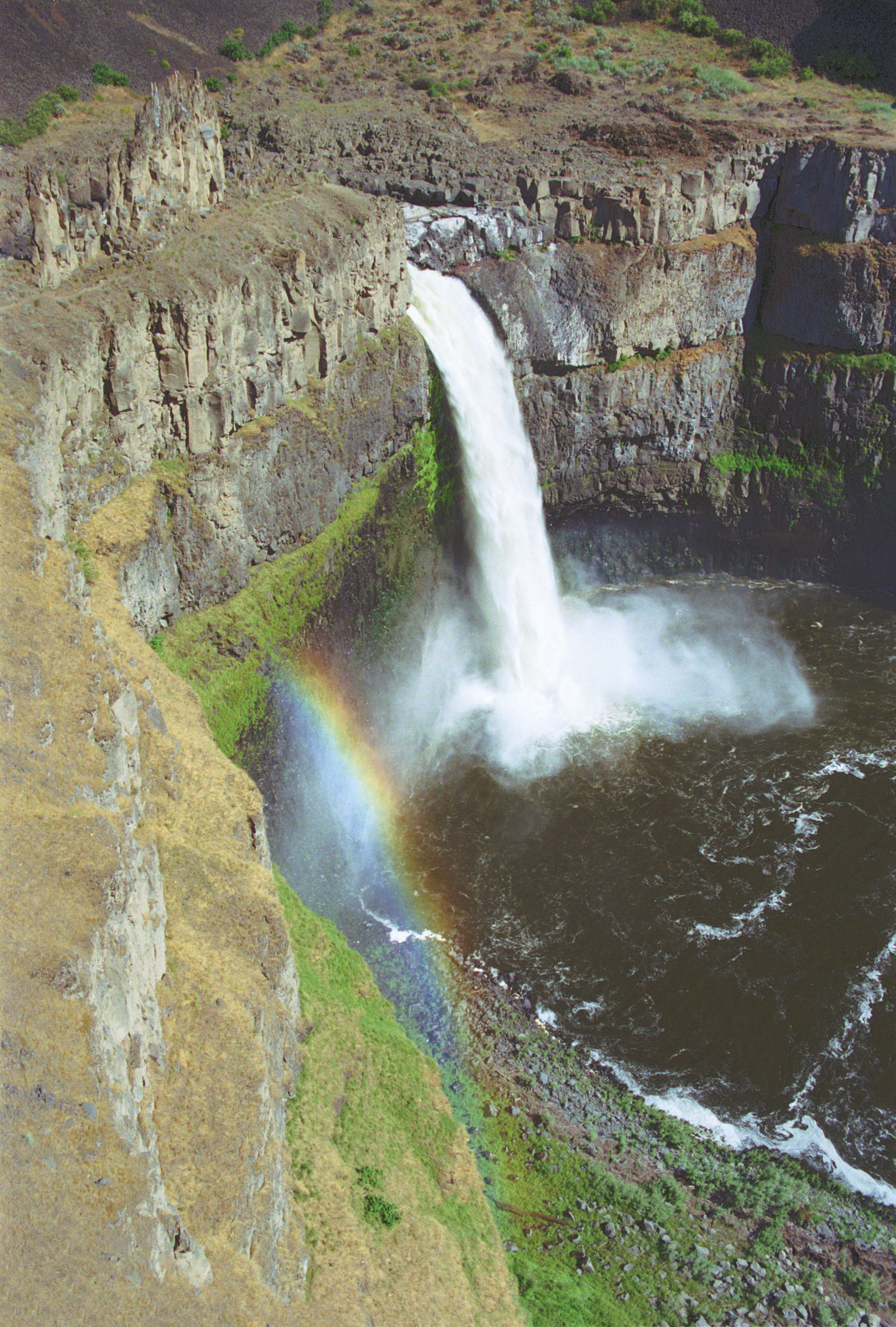
On limits

“I hope it encourages people not to run huge waterfalls but to understand that the only limits that exist are the ones you create, no matter what you are doing.”
[Tyler Bradt, in Kayak Session Magazine interview]
Palouse Falls [Photo credit:D S Dugan]


(Forgive the departure from home range limitations, but I couldn't resist this one.)

Thursday, May 14, 2009

Speaking of Grizz

Here is more Doug Peacock on Democracy Now!, on encountering the wild with respect:

and on addressing the wilderness within:

Don't forget to listen to local radio station KDUR, which broadcasts DemocracyNow! at 12 noon on weekdays, and support the airing of such opinions.

P. S. - Once you've read Dave Peterson's book on grizzlies in the San Juans, think about checking out "In the Presence of Grizzlies, Revised and Updated" [2009, Doug Peacock & Andrea Peacock]. It's newly out in paperback, and I bet your favorite local bookstore can find you a copy.

Monday, May 11, 2009

Ghost Grizzlies revisited in 3rd edition of San Juan Country classic

No one is really sure if Grizzlies will make a comeback in the San Juan Mountains -- but a fine book about the possibility is back.

David Petersen's classic Ghost Grizzlies: Does the great bear still haunt Colorado, first released in 1995 and recently fallen out of print, has just been re-released by Raven's Eye Press in a revised third edition that includes 15 new photographs.

Petersen has updated the story to bring it into the 21st century, but the real value of this book is timeless: Petersen's vivid images of and unabashed love for the San Juan Mountains and the people who inhabit them -- and for the bears that once, and may still, also call them home.

Here's a review I wrote when Ghost Grizzlies was first released. It's still every bit as relevant now as it was then -- as is the book itself.

Colorado is a land of wilderness with the "wild" removed, argues Durango-based author David Petersen, where the back country has been sanitized by the systematic elimination of the wolf and the grizzly bear. Still, he muses, the San Juan Mountains are "another Yellowstone waiting for permission to happen." And what might give the San Juans that permission is the discovery of a surviving population of native grizzlies.


The search for those wild stragglers is the story at the heart of Petersen's latest book, Ghost Grizzlies, which also offers an affectionate and educational look at the San Juans and the distinct and persistent species of bear it spawned and may still support.


>Still, the search is for more than just animals. "The grizzly is a universal metaphor for wilderness," says a member of the team searching for the great bear in Colorado. "The ultimate question we're raising is: How wild do we want the San Juans to be?"


It is this question that underlies the journalistic look at the issue of whether grizzlies exist and should be allowed to survive in the San Juan Mountains. And for Petersen, the probing of this question is also a personal journey, one that through his evocative and deeply personal writing he takes us along on, both on the ground and through his thoughts. It is a journey well worth taking.


Since 1951, the official line from the Colorado Division of Wildlife has been that the San Juan Mountains are inhabited by "lots of black bears but no grizzlies."

This line continues despite the 1979 killing of an adult grizzly sow (who had at some point in her life nursed cubs) in the South San Juans and a continuing trickle of reports of grizzly sightings. Since the land management agencies refuse to act on those reports, the private San Juan Grizzly Project has for several years now studied and compiled evidence -- yet no live bears -- that indicates that at least some grizzlies survive in the San Juans. But "evidence is not proof," the agencies counter.

Petersen offers up this evidence but goes on to examine some tough questions: Even if it is proven that grizzlies survive in the San Juans, is extinction of what may be a distinct subspecies inevitable? To prevent that, should bears from other regions be introduced? To what degree should human uses of the land be limited? Or an even tougher question: Would it be best for the grizzlies themselves to not prove they exist since they have gotten by so far without special treatment?


Petersen doesn't answer those haunting questions, but that is not his goal anyway; his goal is to inform the public that will have to, and he believes should, decide the fate of the grizzly bear -- either native or introduced -- in Colorado. He does this by letting the major players from all sides discuss those questions, plus he offers what information is known and some personal reflection, and then presents this full picture.


All in all, this is a lot of good work resulting in a hell of a good book. Petersen is not objective about the issue -- he openly states that he hopes grizzlies are out there in our extended back yard -- but he has been commendably fair, accurate, and thorough. This is honest journalism, the toughest to write.


But Ghost Grizzlies is more than mere reporting. It is many things -- investigative journalism, history, natural history, social commentary, personal narrative and an essay on the value of wilderness -- but these mesh to form a whole bigger than the parts. They combine to become story, the story of the late-20th century San Juan Mountains.


This is also a human story. Petersen brings to life the people, both historical and alive now, enmeshed in the grizzly history, and it is these characters that make the San Juans real as a place where people were and continue to be molded by the landscape. Included in these tales is a humorous venture with the last man to legally kill a grizzly in the San Juans, a long talk with the outfitter who was mauled by, and then killed, a supposedly-extinct San Juan grizzly in 1979, and several walks with a South San Juans rancher who believes there are still grizzlies on his property. "I hope we're right," he says. "The grizzly is welcome here."


These in-depth and honest characterizations and personal revealings -- like the fact Petersen admits to very much liking the former government trapper who shows no remorse over killing grizzlies -- shows Petersen is mature enough a thinker and person not to resort to easy stereotypes or simple battle lines in this issue he is so deeply involved in.


And these encounters also make the author himself a character as he muses on the fate and significance of the San Juan Grizz. Like the other grizzly defenders he finds -- mostly ranchers and outfitters and hunters -- we see that Petersen is no New Age, dreamy-eyed, posy-sniffing nature mystic. He is a Vietnam veteran, a hunter, and backcountry walker who likes his fireside shots of bourbon.


It is through this woodsman's sense and naturalist's knowledge, spiced with a good sense of humor and an unabashed love for this place, that Petersen's book enters the realm of the finest nature writing, for he manages to make us feel the value of the real wild San Juans. Which is what this book is really about, with the Griz as spiritual symbol, as historic linkage, and as biological litmus test.


As Petersen himself says: "by working to save the bear and its tiny wilderness enclaves, we are working to save ourselves."


Learn more about the third edition of Ghost Grizzlies here.

Visit David Petersen's website and order his books here.

Saturday, May 2, 2009

GO-ing small

"The little things? The little moments?" once queried Buddhist writer John Kabat-Zinn.

"They're not little," he answered himself.

In fact, for some of us, they're damn near everything.

For about a third of the year, working at least one day per weekend and several nights a week is the norm for me. That's because I've crafted my life to be driven by a sort of migration pattern: I work hard in the Fall, Winter and Spring, and the Summers I keep for me.

This doesn't mean I don't "work" in the Summer -- it just means I work at what I want. I work on creative writing, I do personal research, I explore things and places and activities, and I work on my other personal business ventures. I let my spirit go places the places it craves.

And I get out: In the Summers, my family and I venture forth on many long and short trips, both nearby and faraway -- including epics over the past several years that have included long, extended trips to Europe, Norway, Northwestern Canada, Alaska, and the Upper Peninsula of Michigan.

And that philosophy is something my wife and I have endeavored to pass onto our kids: GO!

Because to me, GOing is what it's all about. And so you should carefully strategize your life to maximize your ability and opportunities to GO!

Like any good migration pattern, though, the yang requires some yin. So my yin is in -- meaning, indoors, a lot, for a big chunk of the year. So, in the non-Summer months, I give myself over to closer-to-home ventures: teaching, free-lance writing, running a karate club, and managing the other little businesses I've got going to help forge this piecemeal occupational existence I attempt to live off. And it damn near fills my days -- and nights, and weekends.

But that doesn't mean I don't still hanker to GO. It's just that that GOing has be sneaker and closer-to-home than in the big open of Summer.

So in these seasons of long days and nights hammering away at business busy-ness, I feed the need in me to GO! with lots of little snacks rather than the big fun feasts of Summer venturing.


This observation was driven home to me the other day when my son gave me a hard time for working on a weekend day. His intentions, I like to think, were noble: to return to me the favor of raising him to appreciate getting out a lot by calling me on my staying in a lot.

That's when I took stock of all the little GOings I manage to squeeze into the days ostensibly passed with my nose to the proverbial grindstone: Short walks with the dog. Longer -- but still quick -- runs. Bursts of karate practice in the back yard. Grading or writing out in the sun on the deck. Commuting on foot to my various obligations. Doing errands in town on my cruiser. Soaks under the stars with my wife and kids in our hot tub. Meals taken out on our front porch. And then there's the nights once or twice a week spent sleeping out in the back yard ...

Little things, but deliberate things. Meaningful things. Brief but powerful things that put me into physically, tangibly, meaningfully into the world around me -- the traveling traveling at home, every day -- and all woven into the thick fabric of my packed-to-bursting days. Not big going-aways, but GOings nonetheless.

In these busy months I may not be able to go far, but GO! is still my philosophy, my mantra, war cry, my life purpose. So I still GO, even at home. GO at home. Or, as I've come call it for short, GOh!.

And I'm going to teach that to my kids, too -- Fall, Winter, and Spring. Go! And GOh! even more.

Tuesday, April 28, 2009

Highway of Dreams

It'd be funny -- as I'm sure it is to the rest of the country -- if it wasn't so sad, ugly, expensive, arrogant, wasteful, and stupid.

I mean, of course, Durango's enormous new partially constructed -- and, we learned last week, absolutely worthless -- highway overpass and its surrounding traffic-strangling construction zone on US 160 east of town. This metal and concrete monstrosity spans the highway like the swollen leg of some out-of-context roller coaster, someday to swoosh traffic downward to smoothly merge with the highway and siphon cars and trucks off the highway and up onto the mesa south of the road.

The reason for such an elaborate traffic contraption in a wee backwoods community like Durango was that CDOT had decreed that US 550 -- gateway to Farmington -- needed a rerouting from the long, steep cut in the side of Florida Mesa that leads that north-south traffic down to its confluence with the east-west-running US 160.

Which is fine. But CDOT, in its manic road-building madness assumed it would acquire the land required to, well, connected the new span with the present highway. Now it seems the landowner in that path ain't too happy with the idea.

Seems it now ain't gonna' happen ...

Last week, the Durango Herald reported that CDOT now admits the the overpass will never connect. Still, no mere waste nor foolishness will stand in the way of the Highway Builders! The project,says CDOT, is going ahead with ints next phase, need be damned!

So far, the project has cost $35 million, including $4 million received from the federal government's 2009 American Recovery and Reinvestment Act.

Meanwhile, the Durango 9R school district is laying off 19 teachers and staff ...

Maybe they can get jobs flagging for the new Durango Ornamental Overpass.

But, CDOT assures us, it won't go to waste. "It will serve its function in providing access to U.S. 160 for those north of the highway," says the Herald story. (I assume it means "south of the highway," otherwise the overpass has some other problems. Which, I suppose, wouldn't be a complete surprise.) Which means it's only a small exaggeration to say this $40-million-plus bridge will serve, like, seven people (who have already said they don't want the bridge) and six thousand cattle.

Seems appropriate to me that this item appeared on the front page of our local paper on the 20th anniversary of the release of the movie "Field of Dreams," and its culturally embedded catchphrase, "If you build it, they will come."

Exactly.

Because that is exactly -- I mean aside from its Hell-bent money-wasting land-ravaging road-building mania (see also: Pass, Wolf Creek) -- my gripe against CDOT: If you build it, they will come.

See one of the things that led my wife and I to throw out our anchor and set up our lifetime base camp here in the Four Corners was one interesting fact: It’s about as far away as you can get from an interstate in the continental U.S. That’s changing, though. Even if there's no official designation, you can now follow a nearly a defacto interstate from Albuquerque to Salt Lake City.

Why don't we embrace the fact that the Four Corners is remote. And that most of us like it that way. That that's a valued characteristic. That in the future, as we evolve into new economies, that may be its greatest asset. That it's a condition that will serve us and our kids in the future.

Toward that end, I have a modest proposal: I’d like to see CDOT become simply a fleet of ten thousand pickups with dirt and shovels in the back.

The department will hire anyone who wants and needs a job -- a great way to support high school kids, ski bums, off-season river rats, anyone else who just wants to make few bucks to get to work out of doors. Then they'll just ... drive around, look at the scenery, pick up trash, help wayfaring strangers and RVs bedazzled by what will ultimately become an increasingly degraded series of roads over time, a process of road-to-trail evolution that will only be minimally mitigated by the labor of these CDOT employees in pick ups shoveling loose dirt and asphalt into the decaying pavement -- as the Western Slope of Colorado blossoms in a new cultural revolution linked directly to its return to its status as a hard-to-get-to place.

And someday our kids will take their kids out for a walk along the highway-turned-bikepath that rises from the old highway in a marvelous structure that swoops up onto the wooded mesa above -- an lasting monument to a time when people didn't know any better.

Now that's my kind of field of dreams.

******

This post also appears on InsideOutsideMag.com. Check it out!

Sunday, April 26, 2009

Everett Ruess: Mystery (Almost) Solved

Everett Ruess, that young vagabond who sparked the gleam of adventurous mystery in many an eye, has been found for sure. He was originally lost in Utah 75 years ago. His disappearance assured his place in the annals of wild desert mystery, earning his name mentions by everyone from Edward Abbey (liked his fellow desert rat) to Jon Krakauer (used him as a comparison to Into the Wild protag Chris McCandless) to Wallace Stegner (his kindest words about the whippersnapper were that he wrote "barbaric adolescent yawp"), to, um, bloggers everywhere.

Hats off to you, kiddo, for remaining silent for so long, and for urging dreamers to keep on dreamin'.

Friday, April 24, 2009

R-U-There?


You-Are-Here Pass

We’ve named the mountain passes,
fastened brass plaques where we stop
and sigh, but nothing in the natural world
remembers its name.

The wilderness answers to its own
wide spirit, counts any moment
like starlight that arrives unburdened
by the calculations of time.

“You are here” says a dot
on the map I unfold.
“You are not” says the rock
where I plant my foot.

Home = land, Peacocks, ol' Ed, and bear country!


Democracy Now!, locally available on Durango's own community radio KDUR, has been traveling the western reaches, giving voice to seldom-aired commentaries on the madding empire. In the above interview, Doug Peacock echoes a phrase voiced just yesterday by our own, ever-lovin' sabot-packer, Ken Wright.

Amy Goodman has been soliciting story ideas from the areas they are visiting on this tour, and she will be speaking at the Green Festival in Denver on May 2. Got one?

Thursday, April 23, 2009

More on the Misplaced Monument ...


The Cortez Journal -- confronting what might be the biggest story to hit the area since the whackos with guns rampaged through town and disappeared into the wilderness 10 years ago -- has done some fine journalistic investigation into the case of the apparently misplaced Four Corners Monument. (Three-Point-Nine-Seven Corners M0nument ...?).

It seems the monument isn't really misplaced, it's more, like, just confused.
The boundaries of most Western states were created based on the Washington Meridian, not the Greenwich Meridian, which accounts for the 2.5 mile miscalculation made by geocachers who probably used the Greenwich Meridian. The United States began using the Old Naval Observatory in Washington, D.C., as a surveyors starting point in 1850, but switched to using the Greenwhich Meridian - the world's Prime Meridian - in 1884, according to the Ordnance Survey, Great Britain's national mapping agency.

The Four Corners was designated based on an 1875 survey. Subsequent surveys have shown that the 1875 survey was about 1,800 feet - not 2.5 miles - off, Doyle said. Had the survey been accurate, the Four Corners would have been designated about 1,800 feet east of its current location. Even so, an 1,800-foot discrepancy was still fairly accurate considering the surveying equipment used in 1875.
All this surveying stuff is just all around confusing in general, the article concludes.

Information gathered by Senior Geologist Bill Case, of the Utah Geological Survey, found that the original Four Corners surveyor, Chandler Robbins, missed the mark in 1875 due to problems with early surveying techniques and rough terrain. Robbins' diary from the Utah Historical Quarterly stated, "The needle of the compass had lost its power, which I did not discover until we had entered upon the survey."

Low-powered telescopes, combined with having to use the solar system to survey, made accuracy difficult. And that didn't begin to describe the hassle with vegetation, mosquitoes and wide ranges of elevation, Case said.
Actually, the article is kinda fun and interesting. Check it out here.

I'll take that news over more stories about dipshits with firearms any day.

What's in a name?

I've lately noticed an interesting trend: several people I know have asked to be called something different. Often those new names are comprised of nouns, and sometimes adjective-noun combinations, that aren't, shall we say, generally aligned with traditional naming practices.

Not that there's anything wrong with that. So, being an open-minded and polite sort, I have endeavored to acknowledge and adhere to their requested new self-monikers, while at the same time working to stifle any snickers that might try to burp up unbidden.

The funny thing is, even though I can't seem to help smirking, I don't really think people giving themselves new names is funny. Or bad. In fact, in a theoretical way I fully support, and even embrace, the concept. Yet when it actually occurs, when someone I've known and engaged with for a long time under one name suddenly, willingly, deliberately decides to change their name to some plant or animal or celestial event, well, I still can't help but find it somewhat ... peculiar.

But, I get it. Totally. And I am self-aware enough to recognize that my upwellings of cynicism arise not from what I feel, but from what I think -- those reflexive responses conditioned by our social and cultural upbringings. Because in our culture, this is obviously a different process from the accepted ways we usually get our names:

1. Birth, given by parents and family lineage.
2. Nickname, given by others.
3. Marriage, last name only.
4. Earned and bestowed honorific.

Beyond that, cultural conditioning teaches us to distrust and resist self-imposed re-identifying of ourselves.

Of course, despite these norms and conventions, renaming ourselves is actually quite normal and common -- if we define "normal" as including full variety of human culture, and see what is "common" across the full multi-million-year historic range of human society and culture. In those terms, there's strong evidence that what is "normal" for people -- what transcends our present-day accepted acculturation, and instead arises from our very source, our being, our human being -- is something quite different.

In that broader context we can see that the act of finding and adopting new self-chosen names, often several times in the course of one's life, is actually normal, expected, anticipated, sought out and celebrated.

Yet while this might be common and consistent among tribal peoples worldwide, we think that a singer changing her name to "Pink" is somehow silly and juvenile, different from a Native warrior who has a pwerful vision and so changes his name to "Crazy Horse."

But is it, really, that different?

And we still do it, anyways, don't we? In the business world, it's called "Rebranding." The idea is, essentially, if you rename it, they will come around -- around to seeing your product in a new way, they way you want it to be seen. Think of "Gatorade" now just becoming "G."

Another interesting and new place where people are now renaming and reinventing themselves themselves is online -- emails, discussion groups, chat rooms, social networking sites. And, importantly, and more pervasively, in online gaming, where a participant can create a whole new persona, from name to completely new identity, personal history, and personal story -- a completely new who-you-are. These new identities are called "Avatars," and they can represent, I believe, not just a fantasy, or even an escape, but one of our deepest and most natural human desires: To start over. To be re-invented. To look ahead to believe who we can be, not just who we have been.

And it all begins with our name.

The point being -- it's something many of us want to do. And I think it's something that would be good for most, if not all, of us in our ongoing personal development. Because when you think about it, being stuck with only one name throughout your entire life really only benefits bureaucracy and organizations and those who want you to be permanently attached to your past and your assigned designations. And the result is just that: We are anchored to our past instead of liberated to move to new ways of being.

Seen that way, then, name changing is a sort of spiritual rebranding, with the purpose of recasting ourselves not as histories, but as fresh stories -- from who-we-were to avatar. A new name drops the old storehouse of history and past, and instead works as a compass bearing, a guide, a reference point. It becomes an intention.The idea is, if you rename it, you yourself will come around -- you will live up to that, work toward that, make it so ...

Well, I've been thinking about this since my recent encounters with my friends-formerly-known-as-whatever, and although I can't yet bring myself to rename myself (What would it be? "MoneyMaker"? That would be a welcome change, for sure. "Pulitzer"? It'd take more than a name ... "UpWright," on the other hand, might help my boating ... ), I do see some places where some renaming-towards-revisioning some things might be a real asset right here in our American West. Here are a few ideas:
  • "Public Lands" could be renamed "Grandkids Lands."
  • "Recreation" could be phrased "re-creation."
  • The term "lake" could be applied only to acts of God rather than acts of engineers.
  • "Wilderness" could be called "Homelands" (retrieving the name from the agency of that name), and urban/suburban blights could be labeled "wilderness" -- then we could get back to taming the "wilds" and forging them back into "homelands" again.
Well, it's only a thought. Only a start.

How about you? What would you like to rebrand, and why?

******

This post also appears on InsideOutsideMag.com. Check it out!

Tuesday, April 21, 2009

Some things change, and some don't

This is a not so sweet summary of the EPA's announcement last week that it will regulate greenhouse gases, if Congress cannot find a way to do it first.

Here's a summary of the science behind the proposed action, and how to comment. On both sides of the budding war-o'-words, others are already weighing in. In an interview with ABC News over the weekend, U. S. House Republican Leader John Boehner said, "George, the idea that carbon dioxide is a carcinogen that is harmful to our environment is almost comical. Every time we exhale, we exhale carbon dioxide. Every cow in the world, you know, when they do what they do, you’ve got more carbon dioxide. And so I think it’s clear…"

Incidentally, the EPA's summary does not contend that CO2 is directly carcinogenic, and Boehner seems to have confused carbon dioxide with methane (another of the gases indicted in the EPA documents). Here's an overview of recent increases.

U.S. Greenhouse Gas Emissions by Gas. [Reference: Inventory of U.S. Greenhouse Gas Emissions and Sinks: 1990-2006, USEPA #430-R-08-005]

Regardless of facts, Congress can exempt industries from following such seemingly powerful laws as the Clean Air Act, and John Boehner's Congressional position gives him a very large stick in the debate over how to address some gorillas affecting (and fed by) our neck of the national woods.

Some recent history:

(As referenced above, H. R. 7231 was sponsored by Colorado Representative Diana De Gette in the 110th Congress, and co-sponsored by John Salazar. It died in a sub-committee.)

Monday, April 20, 2009

Four Corners Monumental mistake?

It seems X doesn't mark the spot after all.

The Desert News reports that the popular monument that is supposed to locate where the states of Colorado, Utah, Arizona, and New Mexico meet is actually ... about 2.5 miles west of where the states really do converge.

According to the article:
The true location would be downhill to the east of U.S. 160 in Colorado and northeast of the San Juan River as it flows into New Mexico.
The article offers a brief but interesting history of the site, and say a surveying error led to the misplacement of the monument. Over time the new location has become legally binding. Seems, too, that Colorado and New Mexico gained from the error, while Utah and Arizona lost some turf.

There are no plans to move the monument, though, the article states.

Read the article here.

Friday, April 17, 2009

Launching the 2009 river season: Take me to the river ...

... Drop me in the water.

It wasn't how I planned to launch the river season -- or the Next Big Life Project I'm on. But somehow it was the PERFECT way to launch both:

With a hefty heapin' helpin' of humility.

See, I was cocky. No doubt about it. My buddy Jono was visiting from San Francisco, and for his last day I planned a grand -- and very nearby -- adventure: a canoe float down a stretch of our home-town Animas River. It would be, I assured him, just a two-hour cruise ...

... a two-hour cruise ...

Jono and I have been on several multi-day canoe ventures together, so this one seemed like a leisurely trip -- from Baker's Bridge, at the north end of the grand Animas Valley, down to Trimble Lane, where we usually put in for our canoeing day trips down the valley to town. This stretch is, I had been assured by a kayaking friend of mine (renown for his class- V paddling expeditions, which should've suggested to me that I get a second opinion), a flat-water float through wide, slow, low-water meanders.

It was, he assured me, just a ... two-hour cruise ...

With Spring starting to spring, the river season a'comin', and my paddling pal in town, I decreed that this quick two-hour trip also, then, would be the first run of my life's next Big Project: Over the next few years I will paddle my canoe down the lengths of the San Juan and Animas rivers, as both my 50th Birthday pilgrimage, and also to serve the narrative thread that will run through my next book.

So with all those auspicious beginnings afoot, I knew: It was going to be a great day!

But I was cocky. It was, after all, flat water. (Even if I'd never actually seen this stretch myself ...) And we are experienced paddlers. And it is right close to home. (Even if one of the themes of this book-to-come is the adventures to be had that lie close to home ...) We wouldn't need much, then. Floatbags? Naw. Hell, I'll bring a little token bail bucket. Spare paddle? Ha! Ballast? I'll throw in a couple of bags of gear and a few beers. Dry bags? Well, I'll bring one, but I certainly won't seal it well. And I'll put the rest of our gear -- extra jackets and shells and hats and gloves -- in a day pack and call it good.

After all, it was just a ... two-hour cruise.

For us, it was about a hundred-yard cruise. Paddling anyway. Then we swam. Then we spent an hour running up and down the bank, recovering out boat and gear, and communicating with with comical versions of American Sign Language to our friends who had beached their boats on the far shore so they could gather our various jetsam and flotsam washing up on the other side of the river.

Meanwhile, my beloved canoe sat abandoned and flooded and lodged on a rock (there were a lot of rocks ...) in the middle of the river.

After an hour or so of recover and rescue, I and Jono (whom I, in my cocky "guiding" mode, urged to wear hiking boots and jeans for our mellow, flat-water float) were damn cold. Our "dry bag" was half-full of water and weighed about 50 pounds, full of now-sopping foul-weather gear. Much of the rest of my gear was either redistributed among the still-floating boats or (including our beer) had been sacrificed to the river gods.

We prudently chose to abort.

We humbly chose to abort.

We respectfully chose to abort.

Failure, then? No way. Yes, I still consider that short venture the start of both this year's river season, and of my grand multi-year paddling project. I also, though, now consider it the perfect start to both.

For now I will go into both the right way: With humbleness. And respect. And prepared.

The way one should always go to the river -- whether for a two-hour cruise or a multi-year project.

Our two companions continued on to finish the trip. Meanwhile, Jono and I are determined to tackle this unsuccessful venture again. Hell, maybe we'll make it an annual mission. We could call it the "Annual Baker's Bridge Classic": a triathlon that consists of a hundred-yard paddle, a 20-yard swim, and a three-mile trot along a cobblestone shoreline mostly carrying a 16-foot canoe.

The river will always be the winner.

Check out the pics below. Note that there are no pics of the actual flip, or of my canoe lodged like driftwood in the middle of the river, since my camera was still in the swamped canoe.


******

This post also appears on InsideOutsideMag.com. Check it out!

Friday, April 10, 2009

And now for something completely Vonnegut

Good for You

Two years ago, a man of genius took an awkward fall, which amounted to his last bow, as he left the stage that Shakespeare has compared to this world. On April 11, 2007, this man exited without ever saying a direct word to me. I did manage to see him perform at Fort Lewis College back in the early 1980s and thanks to my friend Bob, I now possess a signed copy of Vonnegut’s Timequake.

If I had my way, Kurt Vonnegut’s name would show up in dictionaries of the future, not only as a reference to the deceased author of Slaughterhouse Five and 24 other literary works, but also as a synonym for telling the truth with just enough humor to make somebody listen. I know it’s difficult to imagine an author’s last name used as a verb, as in The President tried to vonnegut the press conference, but skepticism hung in the air like cigar smoke. Isn’t the use of Vonnegut’s name here so much more pleasing than having to beat around the George Bush?

In his final book, A Man Without a Country, Vonnegut mentions the name of a British general, Henry Shrapnel, a man who engineered a means to send metal fragments out from an exploding shell or bomb, all for the sake of killing and maiming additional victims that the blast did not knock into obscurity. Vonnegut writes, “Don’t you wish you had something named after you?” What a terrible thing, to have Shrapnel’s bloody name preserved in the lexicon and not Vonnegut’s. At least Alfred Nobel had the audacity to obscure his notoriety as the inventor of dynamite by dedicating his fortune to the pursuit of peace. Andrew Carnegie, the steel company magnet, attracted so much wealth that near the end of his life he gave huge sums away to build Carnegie libraries in communities all across the country. He’s remembered for his generosity, not his heavy-handed labor tactics.

Thomas Crapper wasn’t so lucky. Thomas (in this case I prefer the informality of first names) had no vision when it came to foreseeing how posterity would remember him. Or if he did, he must have cringed at his own ingenuity until the day he died.

Vonnegut himself was no slouch at coining words. I remember his invention for achieving space travel with chronosynclasticinfindimulum, and the rhythm of that word has lodged in my brain for over 30 years as musically as Mary Poppin’s supercalifragilisticexpealodosis. I still smile at Vonnegut’s imaginative precursor to Viagra in his novel Slapstick, a sexual practice referred to as bookamaroo where two people press the soles of their feet together for erotic thrills. Of course, he also became the master of transitions threaded throughout his novels, with the likes of So it goes, So be it, Hi Ho, and Good for You.

Like Mark Twain, Vonnegut the humorist got more cynical as he aged. Two of his habits nearly did him in: Smoking in bed – which started a fire in his home – and consuming a regular nightcap, a practice which helped him sleep so soundly it nearly turned him into toast. It is tragic that he once felt so bad about the world where he lived that he attempted to take his own life. That he lived long enough (84) to be disappointed by humanity is not a surprise; that he remained able to laugh up until the end is a miracle.

Thursday, April 9, 2009

Going Full Skier

In the fresh wake of my fortieth birthday, I have relished my last days of the season in April powder, triggering a significant reference—the time when I left “the circle.” It was ten years ago, almost to the date, with lots of late-season April snow, when I left Steamboat Springs.
I can always come back was the motto I embraced and the only way I convinced myself to pack.

A few weeks later, I feigned a confident adieu to my roommates, and pointed my Pathfinder towards the coast. The next day, when I got to Reno, I couldn’t resist exiting the highway in Truckee to check out Squaw Valley. It had been a lonely drive, and I suddenly felt less detached, and even wondered briefly how much housing cost around there. No. I had to remind myself, you're going to the city, not back to what you just left.

Graduate school in San Francisco, for two years, was trying, feeling the magnet of the circle stab me from afar, with my denial that I had left manifesting in nothing very good. I had no idea what I was doing.

Small steps were taken when I returned to Colorado, two years later. And this time, I had a job. There was a ski area, and by-gosh-darnit, I was going to be a skier again. I returned to season passes, albeit weekday Purg passes some years, and I skied.

But, for a while, I wasn’t really a skier. I was skating around the circumference. Living in Bondad didn’t help, surrounded by all that sagebrush. It wasn’t that full-skier lifestyle. My new friends had never seen Aspen Extreme and had no true bond with Scrapple. I paid strangers to tune my skis, full price, so far from the circle that six packs would have been inappropriate.

Finally, this year, I found my way back. Moving to Mancos helped, along with my emergent new ski buddy—a true skier, and also my college pass at Telluride (and utmost kudos to the T Ski Corp for extending the deal to faculty). At home, the La Platas talk to me everyday, and when I’m not on big mountains, I’m still in the spirit, cross countrying on ridgelines above my neighborhood with my dogs. I am on skis most days of the week.

Even better, my new ski buddy is educating me on the whole new world of the backcountry, which is, indeed, quite possibly, the vortex. Early season, he waxed my boards—all three sets—and I feel like a chick in a ski town again, where a little bit of chauvinism is okay. In the backcountry, I marvel at how tired I get skinning up, wondering why running and XC hasn’t put me in better shape. Pointing my skis takes mindset again on these new pitches, allowing alpine turns as I adjust to this more untamed terrain.

I had so many great days in Telluride, too. I love, and have always loved, skiing alone. I returned to this part of my roots, a real mountain and a resort. The ski area isn’t evil to me; it is real. I park at Coonskin, feeling old school, proud with images of hiking Gold Hill before it was a lift, when I made excursions to this magical place during my early liftie days in Summit County. After skiing, before heading back over Lizard Head, I get big bagel sandwiches at Baked in Telluride, liking my strolls through town just as much as the eats. In Mountain Village, I don’t mind the glitz; I liked it, actually, and in the evenings post ski, razzed my ski buddy about my lunch dates with Tom Cruise.

On closing day last weekend, much of Prospect Bowl was still untracked. Hiking up, we take our time, viewing it up. The end-of-year party is starting to gather in the pine trees at the bottom of the first pitch. We won’t go, but we laugh, and I share one of my own last-day memories from Steamboat with him.

He’s always appreciative of my more irresponsible decade. While some of mine are admittedly pretty good, he trumps me altogether with footage he filmed himself at A-Basin in the 70s. (How cool is that?)

We moved down the run confidently and fast, snapping smoothly and consistently into each pivot, our muscles and minds in good shape after a full season. At the bottom, I feel like it is the best day of the year, or maybe even my best day ever, but how many time do we say that? I am back in my slow motion dream and in my own little zone; I am in the circle. I am back.

Tuesday, April 7, 2009

As snow flows to rivers, so we look to floating ...


Well, another ski season is logged in Üllr's books. (Ski area-wise, anyway -- backcountry corn is still yet to come ...)

So if you're like me, then your eyes are now turning from looking upstream to gazing downstream.

Alas, though, even despite this weekend's small gift of April snow, that prognosis looking upstream to see what might be headed downstream as temperatures rise isn't all that promising.

State-wide, the snowpack across the state's seven major river basins was 96 percent of normal on April 1 -- that after having been as high as 120 percent of normal on Jan. 1, after December's mega-storms. In February, reports were calling the snowpack the best since 1997 , including above-average snow in the San Juans -- the Rio Grande basin was 130 percent of average, and the Animas/Dolores/San Juan basins were 116 percent of average (still, though, at only 75 percent of last year at that time).

But then came a warm, dry March ...

According to an AP story this morning, though, this weekend's storm pushed the average back up over 100 percent of average.

In Southwest Colorado, though, the reports aren't quite as bright.

Dolores River

Last year we long-time Dolores junkies felt like were thrown a party and got to binge once again on one of the region's -- or, hell, the damn planet's -- most glorious river canyons. For the first time since the mid-1990s, the Dolores offered up boatable floww from April into June.

This year, though, the Dolores Water Conservation District is now reporting that an early prediction of a month of recreational flows to be spilled from McPhee Reservoir has been scaled back after the dry March. The district's website reports:

March was not a good precipitation month for us. The storms that rolled through brought mostly high winds and dust, and almost no precipitation. The current forecast for April 1 has dropped the spill to approximately 30,000 AF (acre-feet). Therefore our best estimate at this time is that the spring runoff will be below normal. The rafting window has closed some, but water that becomes available will be released around the end of May.

The district predicts:
  • Flows in April will stay as low as 50 cfs.
  • Releases in early May should increase toward 400 cfs.
  • Releases the week of May 11 - 15 may increase to 400 cfs to facilitate Colorado Department of Wildlife fish surveys.
  • After that week flows are projected to rise to rafting levels of 800 to 1,200 cfs.
  • Those flows may last about two weeks and should include Memorial Day.
The district urges boaters to check doloreswater.com around May 7 for updated predictions.

San Juan River

In mid-March, with the San Juan Basin snowpack at just over 100 percent of average, the Bureau of Reclamation was predicting several weeks of releases of 5,000 cfs beginning in mid-May.

Since then, though, BuRec has lower its estimates to as little as a week of high-volume releases.

A public meeting on Navajo Reservoir operations will be held at 1 p.m., Tuesday, April 28, in Farmington. Reservoir operations over last fall and winter will be reviewed, and plans for next spring and summer 2009 operations will be discussed. Contact BuRec's Durango office at 970.385.6560 for information.

******

This post also appears on InsideOutsideMag.com. Check it out!

Sunday, April 5, 2009

Success

I’m in a Cortez-Durango book club that has got to be one of the few coed book clubs in the country. (The NY Times ran a thing on book clubs a few years back, and most of them were all-female. Coed appeared non-existent.) This month we are reading Malcolm Gladwell’s Outliers: The Story of Success. Well, ok. A fairly interesting book, actually, in that he uses unique examples to make his point that the self-made man business is, uh, crap (see Tombstone II blog at Inside/Outside Southwest: http://www.insideoutsidemag.com/community/blogs/As_A_Woman/). Jeb Bush is his cherished fall guy, for when the man “ran for governor of Florida, he repeatedly referred to himself as a ‘self-made man,’ and it’s a measure of how deeply we associate success with the efforts of the individual that few batted an eye at that description.” Malcolm, like me, like deep ecologists everywhere, like Pueblo Indians and yucca moths and grizzly bears, understands that context is everything, and your environmental interactions have a lot to do with what you become in your life.
But, alas, his radical thesis stops there. I read it feeling the perennial Westerner locked out of “Eastern” success. To writers Ken Wright and Craig Childs and Amy Irvine and Art Goodtimes and my friend Gretchen, “success” is not having a well-paying job in a swank setting. It is not, necessarily, following the lines our college and graduate degrees promised us. Ken left the East, as many Abbey-ites do, for river rafting and ski bumming. He has lived for this happily ever after. Craig is driven, an almost OCD writer, but he lived “homeless” for seven years, making a pickup and the canyons his abode. Gretchen’s mother to this day fails to understand why she did not go to law school and marry a rich guy so she could get valances for her suburban windows. Gretchen has three rescue dogs, a craggy boyfriend reminiscent of Nick Nolte, a season pass to Telluride, and a tiny, charming manse in a tiny, charming, Western town with a gay mayor and horses saddled waiting for their owners behind the bar on Main Street.
I have a manifesto in my writing nook. It says things like this:

It doesn’t interest me what you do for a living. I want to know what you ache for, and if you dare to dream of meeting your heart’s longing.
It doesn’t interest me how old you are. I want to know if you will risk looking like a fool for love, for your dream, for the adventure of being alive.
It doesn’t interest me what planets are squaring your moon. I want to know if you have touched the center of your own sorrow, if you have been opened by life’s betrayal, or have become shriveled and closed from fear of further pain. I want to know if you can sit with pain, mine or your own, without moving to hide it or fade it or fix it.
I want to know if you can be with joy, mine or your own, if you can dance with wildness and let the ecstasy fill you to the tips of your fingers and toes without cautioning us to be careful, to be realistic, to remember the limitations of being human….

This manifesto goes on. THAT’S my definition of success. And it’s one the wildflowers tell me, in their profusion, up Kennebec Pass in August. It’s what the elk who catches my eye by the La Plata River thrills into me the moment we connect. It’s the message in the swish of a mountain lion’s tail, the love in my son’s eyes, the marriage I work and work and play and play on so that when I am dying I will know – I had THIS. I had this life, this wonder, this relationship, when so much else was pulling at me to fall apart.
Gladwell does not, needless to say, speak to that at all, and more’s the general pity. Alas and alack, New York is still stuck in disconnected, achievement notions of success than in taking his “radical” idea one step further and asking: if we are not so “self-made,” then why do we not value our relationships with each other? Why are the lives and successes of women (children raised, gardens grown, jobs held, husbands outgrown or nourished) rarely if ever mentioned? Why is “success” still defined as some nebulous achievement on a hockey rink or mathematics test? Come West, Malcolm, and we’ll take a little hike. I’ll get Art Goodtimes to howl you a poem at 10,000 feet, and we’ll see if you can go write Success: The Sequel, after that.